
Wondering how to start investing with $500 and build real passive income in 2025? You don’t need thousands of dollars or a finance degree to begin. The truth is, $500 invested wisely today — and added to consistently — is the foundation that builds genuine wealth over time. Thanks to fractional shares, zero-commission brokerages, and high-yield savings accounts, the barriers to investing have never been lower. This guide shows you exactly how to start investing with $500, which accounts to open, which assets to buy, and how to automate your wealth-building from day one.
Why $500 Is Enough to Start Investing for Passive Income
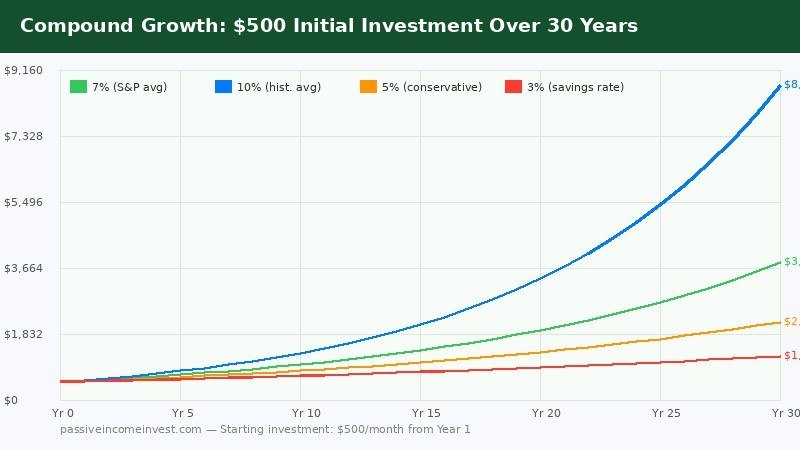
Many people believe you need a large sum to start investing. This is one of the most costly misconceptions in personal finance. Here’s why $500 is more than enough to begin:
- Fractional shares: Platforms like Fidelity and Charles Schwab let you buy $1 of any stock — including Amazon, Apple, and Berkshire Hathaway — regardless of share price.
- Zero commissions: Nearly every major brokerage now charges $0 to buy stocks and ETFs. Your $500 goes entirely into investments, not fees.
- Compound interest: Einstein called it the eighth wonder of the world. $500 invested at 10% annual return becomes $8,700 in 30 years — without adding another dollar. Add $100/month and it becomes $226,000.
- Index funds: A single S&P 500 index fund gives you instant diversification across 500 companies for as little as $1.
How to Start Investing with $500 in 2025 – Step-by-Step
Step 1: Build a $1,000 Emergency Fund First
Before investing, ensure you have at least $500–$1,000 in a high-yield savings account for emergencies. Investing money you might need in 3 months forces you to sell at the worst times. A solid financial foundation always comes before investment returns.
Step 2: Open the Right Account
The account type matters as much as what you invest in:
- Roth IRA (best for most beginners): Contribute up to $7,000/year (2025). Investments grow tax-free and withdrawals in retirement are tax-free. If you have earned income and are under 50, open a Roth IRA first.
- Traditional IRA: Contributions may be tax-deductible. Best if you expect lower income in retirement than today.
- Taxable Brokerage: No contribution limits, no withdrawal restrictions. Use for investing beyond your IRA contribution limit.
- 401(k): If your employer offers a match, contribute at least enough to get the full match before anything else — it’s an instant 50–100% return.
Step 3: Choose What to Buy
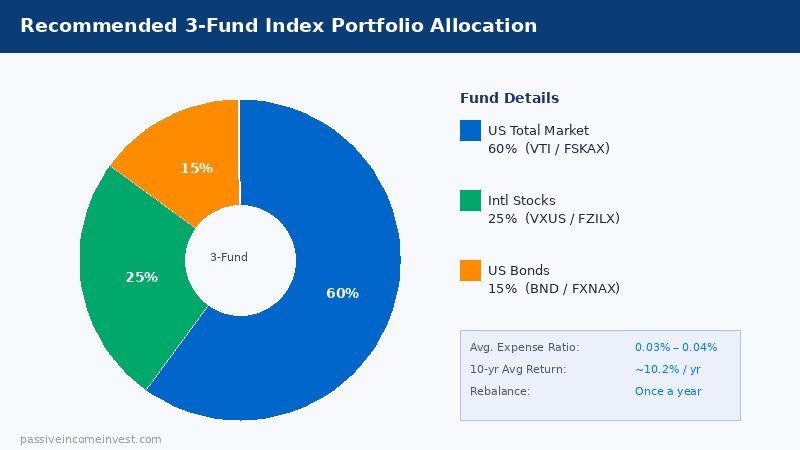
For most beginners with $500, a simple 2-fund portfolio is optimal:
- 70–80%: S&P 500 Index Fund — e.g., Fidelity ZERO Large Cap Index (FNILX, 0% expense ratio) or Vanguard S&P 500 ETF (VOO, 0.03% expense ratio)
- 20–30%: International Index Fund — e.g., Vanguard Total International Stock ETF (VXUS) for global diversification
This two-fund portfolio beats the vast majority of actively managed funds over any 10-year period. Keep it simple until you understand what you own.
Step 4: Automate Your Contributions
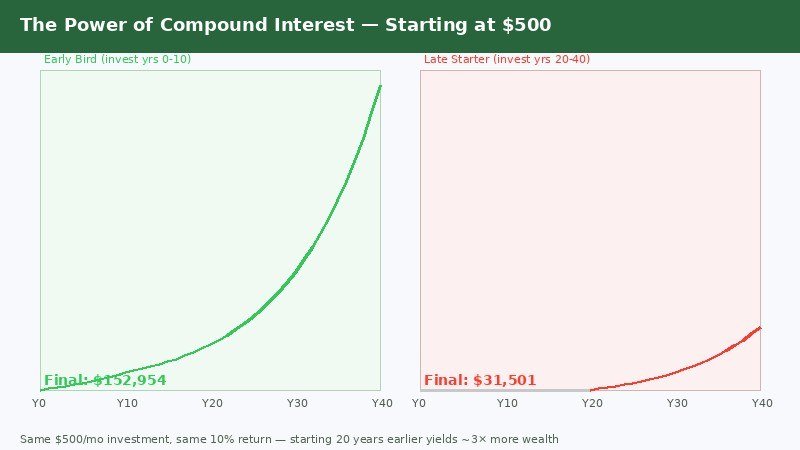
Set up automatic monthly transfers from your checking account to your investment account. Even $50–$100/month added to your initial $500 dramatically accelerates wealth building. Automation removes emotion from investing and ensures you buy consistently — including during market dips when prices are lowest.
Step 5: Reinvest All Dividends
Enable DRIP (Dividend Reinvestment Plan) on your brokerage account. Every dividend payment automatically buys more shares, compounding your returns without any action required. This is the core engine of passive income investing.
Best Investment Accounts for Beginners with $500
Fidelity – Best Overall for Beginners
Fidelity offers zero-commission trading, fractional shares starting at $1, and ZERO expense ratio index funds (FZROX, FNILX) that literally charge nothing to own. Their interface is clean, their customer service is excellent, and there’s no account minimum. For a beginner with $500, Fidelity is the optimal starting point.
Charles Schwab – Best for Automatic Investing
Schwab’s automatic investment feature lets you set up recurring purchases of any ETF on a daily, weekly, or monthly basis — perfect for dollar-cost averaging. Schwab also offers fractional shares and excellent index funds with near-zero expense ratios.
Vanguard – Best for Long-Term Index Investing
Vanguard invented the index fund and remains the gold standard for long-term passive investing. Their ETFs (VOO, VTI, VXUS) have the lowest expense ratios in the industry. Best for investors committed to a buy-and-hold approach.
Best Books on Investing for Beginners with $500
The best investment you can make alongside your $500 is education. These books will pay dividends (literally) for decades:
The Little Book of Common Sense Investing by John Bogle — The definitive case for index fund investing, written by the man who invented it. Bogle proves with decades of data that low-cost index funds beat virtually all actively managed funds over time. A must-read for any new investor.
The Simple Path to Wealth by JL Collins — Written originally as a letter to Collins’ daughter, this book explains how to build wealth with a single index fund in plain English. The clearest, most actionable investing book for beginners. Covers Roth IRAs, tax-efficient investing, and the 4% withdrawal rule for financial independence.
The Millionaire Next Door by Thomas J. Stanley — A data-driven study of how ordinary Americans build extraordinary wealth. Spoiler: it’s not high income — it’s consistent saving, frugal living, and long-term index investing. This book changes how you think about money permanently.
The Bogleheads’ Guide to Investing — The community guide to Jack Bogle’s investing philosophy. Covers every practical aspect of building a passive income portfolio: asset allocation, tax efficiency, rebalancing, retirement accounts, and avoiding common mistakes.
Passive Income Streams to Build Alongside Your $500 Investment
Investing is the foundation of passive income, but here are additional streams to build simultaneously:
- High-Yield Savings Account (HYSA): Park your emergency fund in a HYSA earning 4.5–5.0% APY (2025 rates). Institutions like Marcus by Goldman Sachs, Ally Bank, and SoFi offer rates 10–15x higher than traditional banks — completely risk-free FDIC-insured passive income.
- Dividend Stocks: Once your index fund portfolio grows, add individual dividend stocks (REITs, utilities, dividend aristocrats) that pay quarterly income. Reinvest early; draw income later.
- I-Bonds: US Treasury I-bonds currently pay inflation-adjusted rates. Risk-free, government-backed, and an excellent complement to stock index funds during high-inflation periods.
- Peer-to-Peer Lending / Private Credit: Platforms like Fundrise offer access to private real estate credit investments with target yields of 8–12%. Higher risk than bonds but significantly higher yield.
How to Start Investing with $500 – FAQ
Is $500 enough to start investing for passive income?
Absolutely. $500 is enough to open a Roth IRA or taxable brokerage account, buy fractional shares of S&P 500 index funds, and start compounding immediately. The key is consistency — add to it monthly. $500 today + $100/month for 30 years at 8% returns = $149,000+.
What should I invest $500 in as a complete beginner?
For a complete beginner, put your $500 into a single S&P 500 index fund inside a Roth IRA. Fidelity’s FXAIX (0.015% expense ratio) or Vanguard’s VOO (0.03%) are both excellent. This gives you instant diversification across the 500 largest US companies with minimal fees and no stock-picking required.
How long does it take to see returns on a $500 investment?
You’ll see returns (and losses) from day one as the market moves. For meaningful passive income — dividends and capital gains — plan for a 5–10+ year horizon. The S&P 500 has returned an average of ~10% annually over the past 50 years. Short-term results vary wildly; long-term results have been remarkably consistent.
Should I invest $500 in stocks or pay off debt first?
If you have high-interest debt (credit cards at 15–25% APR), pay it off first — that’s a guaranteed 15–25% return. If your debt is low-interest (student loans at 4–6%, mortgage), investing simultaneously makes sense since stock market returns historically exceed these rates. If your employer offers a 401(k) match, always contribute enough to get the full match before paying extra debt.
Final Verdict – Start Investing Your $500 Today
Knowing how to start investing with $500 is only valuable if you actually start. Open a Roth IRA at Fidelity or Schwab this week, put your $500 into a total market or S&P 500 index fund, set up automatic monthly contributions of whatever you can afford, and never touch it. That’s the entire strategy — and it has made millions of ordinary people wealthy over the past 50 years.
The best time to start was yesterday. The second best time is today. Explore more passive income strategies, investment guides, and wealth-building resources at PassiveIncomeInvest.com.
Comments
4 responses to “How to Start Investing with $500 in 2025 – Beginner’s Guide to Passive Income”
[…] The best index funds for beginners in 2025 — FXAIX, VOO, FZROX, VTI — are all excellent choices that will serve you well for decades. Pick one, open a Roth IRA, automate contributions, and never stop. For more passive income guides, ETF comparisons, and wealth-building strategies, visit PassiveIncomeInvest.com and check out our guide to investing with $500. […]
[…] started your investing journey? Check out our how to start investing with $500 guide or browse the best index funds for beginners for your first portfolio […]
[…] you’re just starting your investing journey, our guide on how to start investing with $500 covers the fundamentals of getting started. For a broader approach to passive income, check our […]
[…] Read our beginner investing guide to get started. Check our dividend investing strategy for deeper insights. […]