
The best index funds for beginners in 2025 are your fastest path to building long-term passive income without stock-picking, market timing, or paying expensive fund managers. Index funds track a market index — most commonly the S&P 500 — giving you instant diversification across hundreds of companies in a single, low-cost investment. Study after study shows that the best index funds for beginners outperform the vast majority of actively managed funds over any 10-year period. This guide covers the top S&P 500 and total market ETFs for 2025, how to choose between them, and how to build a complete passive income portfolio starting today.
Why Index Funds Are the Best Investment for Beginners
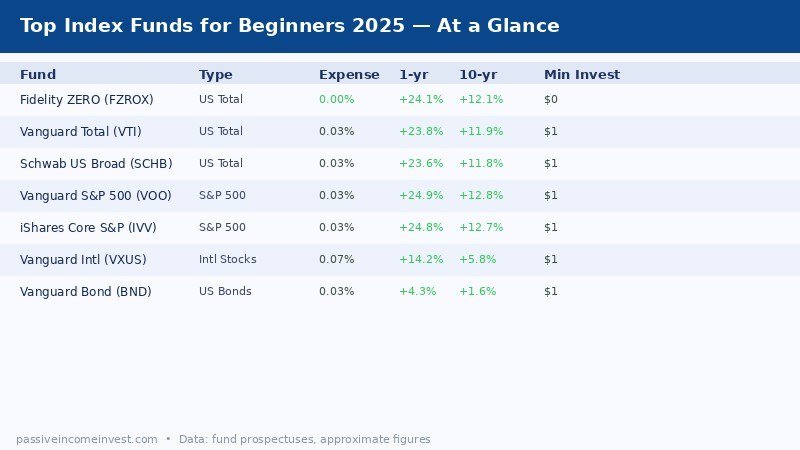
- Diversification: One S&P 500 index fund owns 500 companies — instant diversification with one purchase.
- Low cost: Expense ratios of 0.00%–0.03% vs 0.5%–1.5% for actively managed funds. Over 30 years, that difference compounds to tens of thousands of dollars.
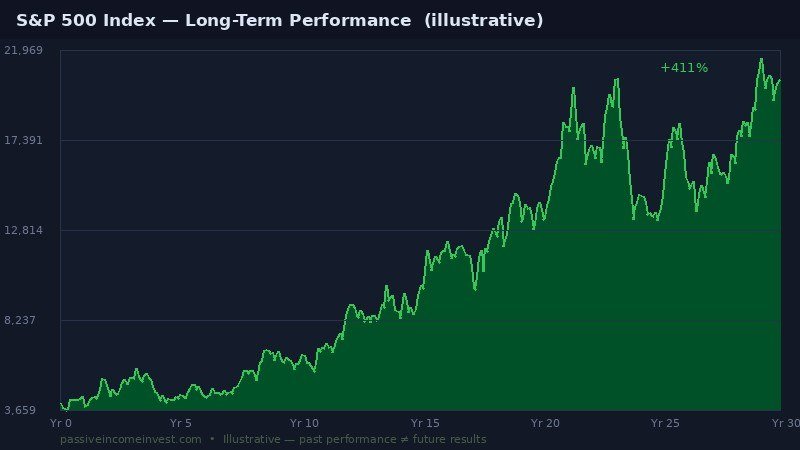
- Proven performance: The S&P 500 has returned ~10% annually over the past 50 years. Over 90% of active fund managers underperform this benchmark over 15-year periods.
- Passive management: Set it, automate contributions, and let compound interest work. No research, no stock-picking, no stress.
Best Index Funds for Beginners in 2025 – Top S&P 500 ETFs
1. Fidelity 500 Index Fund (FXAIX) – Best Overall for Beginners
FXAIX tracks the S&P 500 with a 0.015% expense ratio — one of the lowest available. No investment minimum, fractional shares available at Fidelity, automatic dividend reinvestment, and zero transaction fees. For a beginner starting with $500, FXAIX at Fidelity is the single best option: you pay essentially nothing in fees and own a slice of the 500 largest US companies immediately.
Expense ratio: 0.015% | Min investment: $1 | 5-yr return: ~15.8%/yr
2. Vanguard S&P 500 ETF (VOO) – Best for Long-Term Holding
VOO is the gold standard for passive investing — Jack Bogle’s original vision executed to perfection. The 0.03% expense ratio is industry-leading for an ETF, and Vanguard’s unique ownership structure (owned by its fund shareholders) keeps costs minimal long-term. VOO is available at any brokerage that trades ETFs and is the most widely-held index ETF in the world.
Expense ratio: 0.03% | Min investment: 1 share (~$520) or $1 fractional | 5-yr return: ~15.7%/yr
3. Schwab S&P 500 Index Fund (SWPPX) – Best at Schwab
SWPPX offers S&P 500 exposure at 0.02% expense ratio with no minimums at Schwab. Excellent choice if your 401(k) or brokerage is at Charles Schwab. Performance is virtually identical to FXAIX and VOO — expense ratio differences at this level are negligible over a lifetime of investing.
Expense ratio: 0.02% | Min investment: $1 | 5-yr return: ~15.7%/yr
4. Fidelity ZERO Total Market Index (FZROX) – Best 0% Expense Ratio
FZROX tracks the entire US stock market (not just S&P 500) with a 0.00% expense ratio — literally free to own. Available exclusively at Fidelity, it covers 3,000+ US companies including small and mid-cap stocks. If you want maximum diversification at the absolute lowest cost, FZROX is unmatched.
Expense ratio: 0.00% | Min investment: $1 | Coverage: ~3,000 US companies
5. Vanguard Total Stock Market ETF (VTI) – Best Total US Market ETF
VTI covers the entire investable US stock market — large, mid, and small cap — at 0.03% expense ratio. Historically, total market funds match or slightly outperform S&P 500 funds over very long periods due to small-cap exposure. VTI is an excellent complement or alternative to VOO for maximum US market coverage.
Expense ratio: 0.03% | Min investment: 1 share (~$270) or $1 fractional | Coverage: ~3,600 US companies
Best Books on Index Fund Investing for Beginners
The Little Book of Common Sense Investing – John Bogle — The inventor of index funds makes the definitive case for passive investing. Required reading for every beginner.
The Simple Path to Wealth – JL Collins — The clearest, most actionable guide to building wealth with index funds. Covers Roth IRAs, tax efficiency, and the path to financial independence.
The Bogleheads’ Guide to Investing — Comprehensive practical guide covering asset allocation, tax-efficient investing, rebalancing, and retirement accounts. The community companion to Bogle’s philosophy.
Best Index Funds for Beginners – FAQ
Which index fund is best for a beginner with $500?
Fidelity 500 Index Fund (FXAIX) is the best choice for a beginner with $500. Open a Roth IRA at Fidelity, invest your $500 in FXAIX, and set up automatic monthly contributions. Zero minimums, 0.015% expense ratio, and dividend reinvestment are all included automatically.
Is it safe to invest all my money in one index fund?
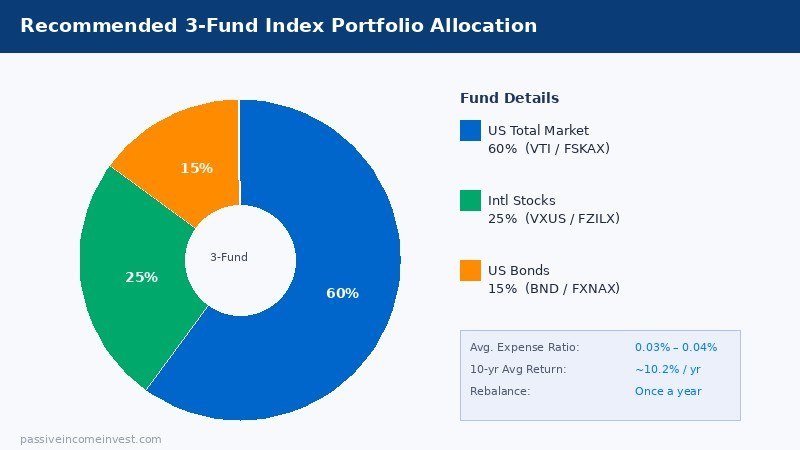
For most beginners, yes — a single S&P 500 index fund is an entirely reasonable portfolio. It already diversifies you across 500 companies. For additional diversification, add an international index fund (like VXUS) for global exposure. The classic “two-fund portfolio” (80% FXAIX/VOO + 20% VXUS) is endorsed by most passive investing experts.
How much should I invest in index funds each month?
Invest as much as you can afford consistently. Even $50–$100/month compounded over 30 years at 8% annual returns grows to $75,000–$150,000. The amount matters less than consistency. Automate your contributions so you invest on the same day every month regardless of market conditions.
Final Verdict
The best index funds for beginners in 2025 — FXAIX, VOO, FZROX, VTI — are all excellent choices that will serve you well for decades. Pick one, open a Roth IRA, automate contributions, and never stop. For more passive income guides, ETF comparisons, and wealth-building strategies, visit PassiveIncomeInvest.com and check out our guide to investing with $500.
Comments
2 responses to “Best Index Funds for Beginners in 2025 – S&P 500 ETFs Ranked”
[…] started your investing journey? Check out our how to start investing with $500 guide or browse the best index funds for beginners for your first portfolio […]
[…] Check our index funds guide for long-term wealth building. […]